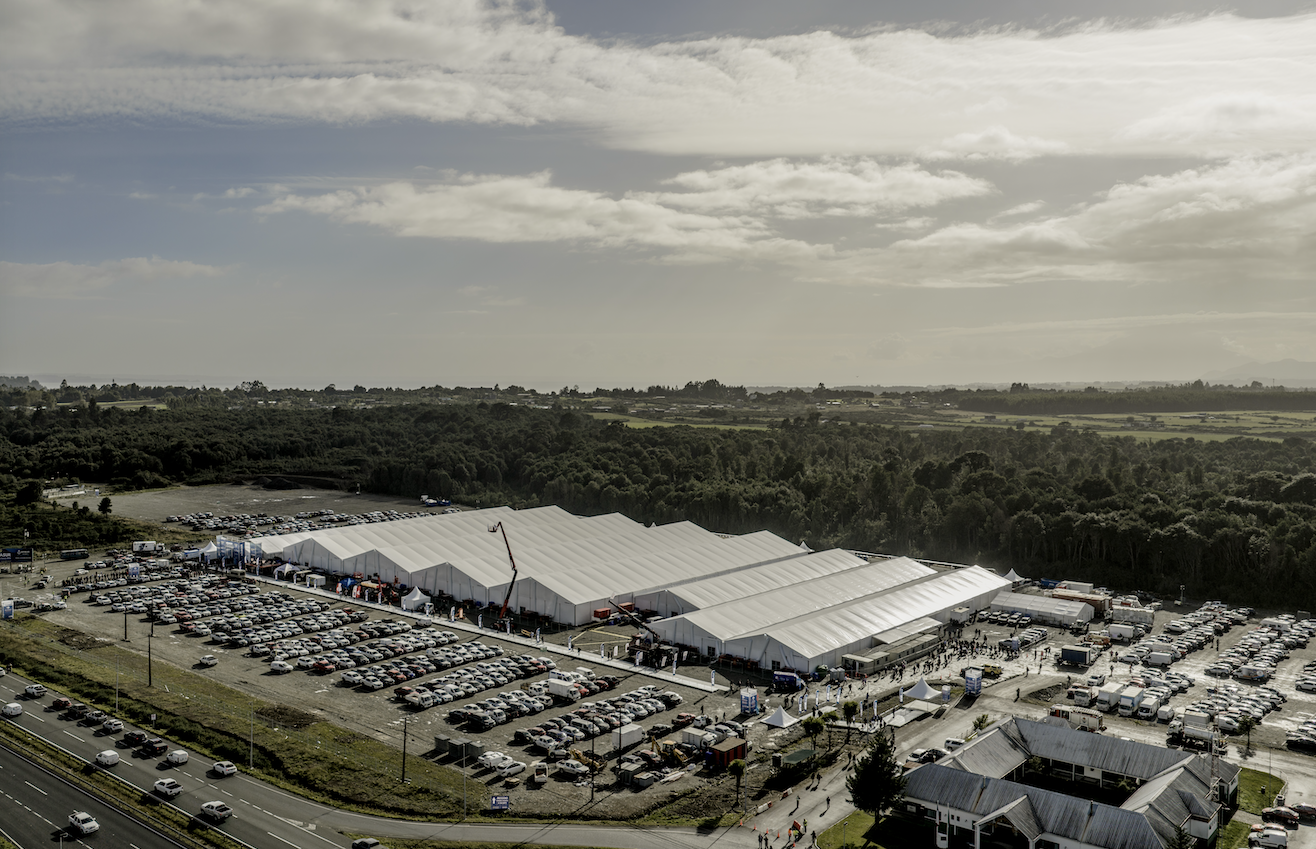
Don't miss the opportunity to participate in the largest aquaculture event in the Southern Hemisphere!
Don't miss the opportunity to participate in the largest aquaculture event in the Southern Hemisphere!
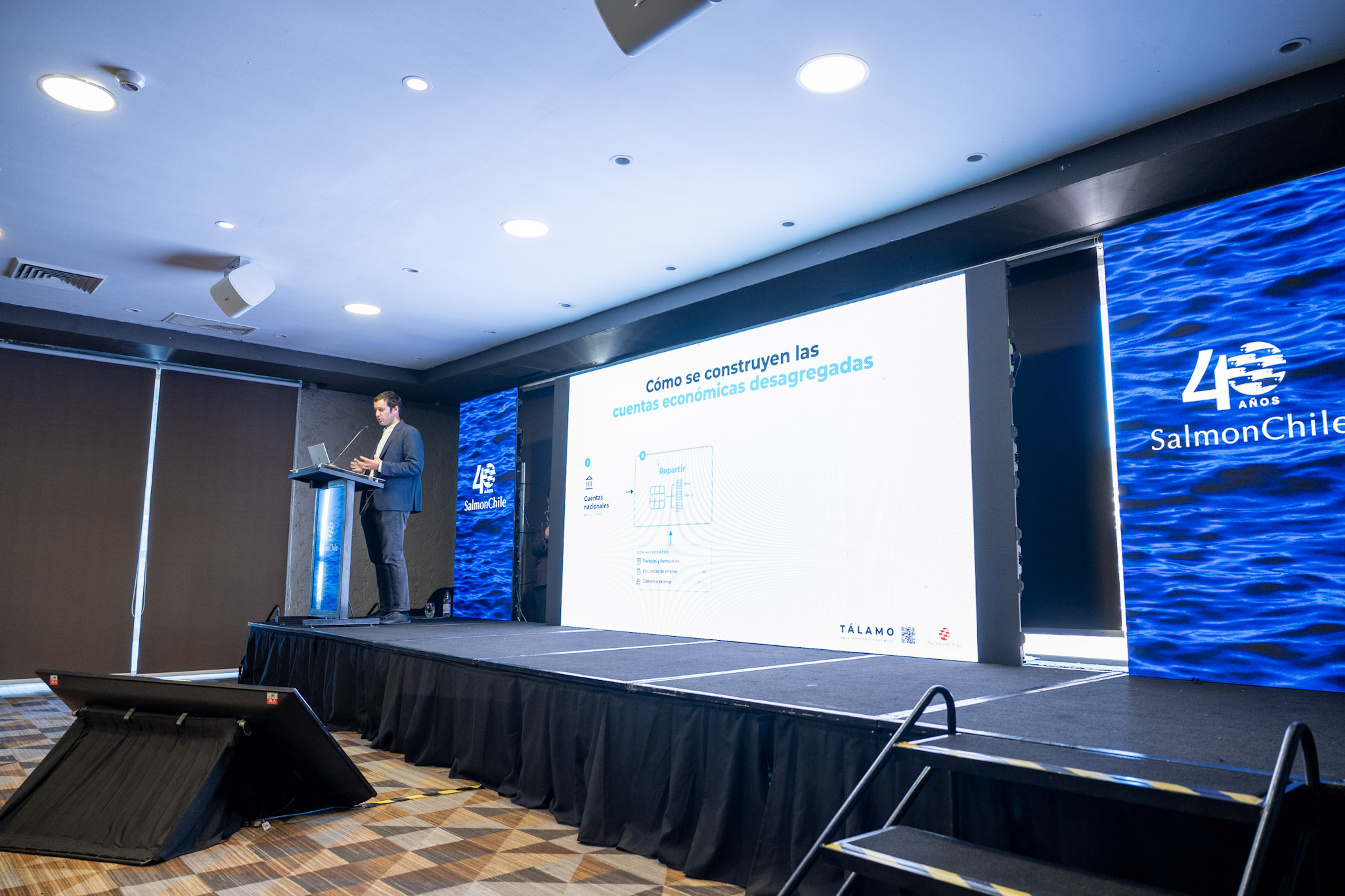

Aquasur was present at the presentation of the study “Economic contribution of the salmon industry in Chile”, an occasion that served to debate the real scope of this productive sector, highlighting from the outset that the salmon value chain contributes 2.6% of the total national Gross Domestic Product, and supports almost 340 thousand jobs throughout the territory.
Aquasur attended a recent seminar organized by SalmonChile to present an in-depth look at the study “Economic Contribution of the Salmon Industry in Chile.” The research was conducted by CoMov Consultores with the guidance of Federico Huneeus, a senior economist in the Central Bank’s Research Division. The event brought together prominent figures from both the public and private sectors to discuss the true scope of this industry, highlighting from the outset that the salmon value chain contributes nearly US$7 billion to the Gross Domestic Product—representing 2.6% of the national total—and supports nearly 340,000 jobs across the country.
During his presentation, Huneeus emphasized that while the industry’s activity takes off firmly in the south, its greatest strength lies in the broad-based dynamism it generates throughout the nation. This is evidenced by the fact that seven out of every ten pesos supported by the industry are generated outside the southern regions, and two out of every three are generated outside the core salmon sector itself. In this light, the report details that the industry supports 337,670 jobs, equivalent to 3.8% of national employment. Of these, approximately 79,000 are directly linked to salmon farming and processing plants, while the remainder extends into logistics, transportation, commerce, and services,meaning that for every direct job, 3.3 additional jobs are sustained.
The impact of this economic engine is felt strongly in the southern macro-region. In Aysén, for instance, the salmon value chain accounts for more than 21% of the regional GDP. However, the impact extends further, reaching areas that lack cultivation centers, such as the Biobío Region, which sustains over 42,000 indirect jobs through processing and related services, or the Metropolitan Region, which accounts for more than 200,000 positions linked to corporate, financial, and logistical operations.
Given this landscape, the president of SalmonChile, Patricio Melero, emphasized the urgent need for up-to-date and rigorous assessments, stating that “to build the salmon farming industry of the coming years, Chile needs evidence-based decisions”. He stressed that having solid data is essential for authorities to legislate effectively and for companies to continue investing with legal certainty, noting that this activity “is not an isolated operation in the fjords, but rather a complex, integrated industrial sector with a national reach” that drives agriculture, commerce, tourism, forestry, and transport. Furthermore, he pointed out that “salmon farming in Chile is of vital importance—not only for the southern macro-zone, stretching from the Biobío to the Magallanes regions, but, as this high-impact study has demonstrated, for the entire country”. He added that the figures show this is “an industry that not only creates jobs but also fosters technological innovation, development, and national sovereignty, while serving as a great ambassador in the international markets where its products are sold”.
In the same vein, former Minister of Finance Ignacio Briones urged a proper appreciation of the value and sophistication of this sector, remarking that “we suffer from a complex where we fail to recognize our own potential… This is an industry with deep added value”, which generates both employment and sophistication. According to Briones, although significant progress has been made with the Sectoral Permits Law, the country remains burdened by a convoluted regulatory ecosystem. “The challenge is clear: we must leverage the conditions we have in Chile—which are currently underutilized—to further develop this industry.” He called for the establishment of an ambitious 20- to 30-year goal, supported by public-private collaboration in which the State acts as a facilitator regarding the permitting process. For her part, the president of Sofofa, Rosario Navarro, agreed on the urgent need to untangle regulatory hurdles and move toward profound reforms—reforms that address both the streamlining of permits and the development of human talent. She noted that “Chile is indeed lagging when it comes to permitting, and we must undertake deep-reaching reforms”, warning that “the ‘permits maze’ has become a bottleneck, and a lack of prepared talent is another such bottleneck”.
Joining this discussion, the Undersecretary of Fisheries and Aquaculture, Osvaldo Urrutia, welcomed these high-level forums and emphasized that “it is important for the public to understand the contribution made by the salmon farming industry—not only in the regions where it is deeply rooted, such as southern Chile, but also in Santiago and other major cities, where the industry sustains a significant number of jobs”.
The event also served to look toward the future of the sector through a video recap of the most recent edition of Aquasur. This audiovisual record highlighted key milestones from the 2026 installment of the Southern Hemisphere’s most important aquaculture trade fair and offered a preview of preparations for the next edition, scheduled for 2028.